ERNIE-Image vs HiDream-O1-Image: 8B Pixel-Native vs 8B Latent — Two Open-Source Paths Face Off
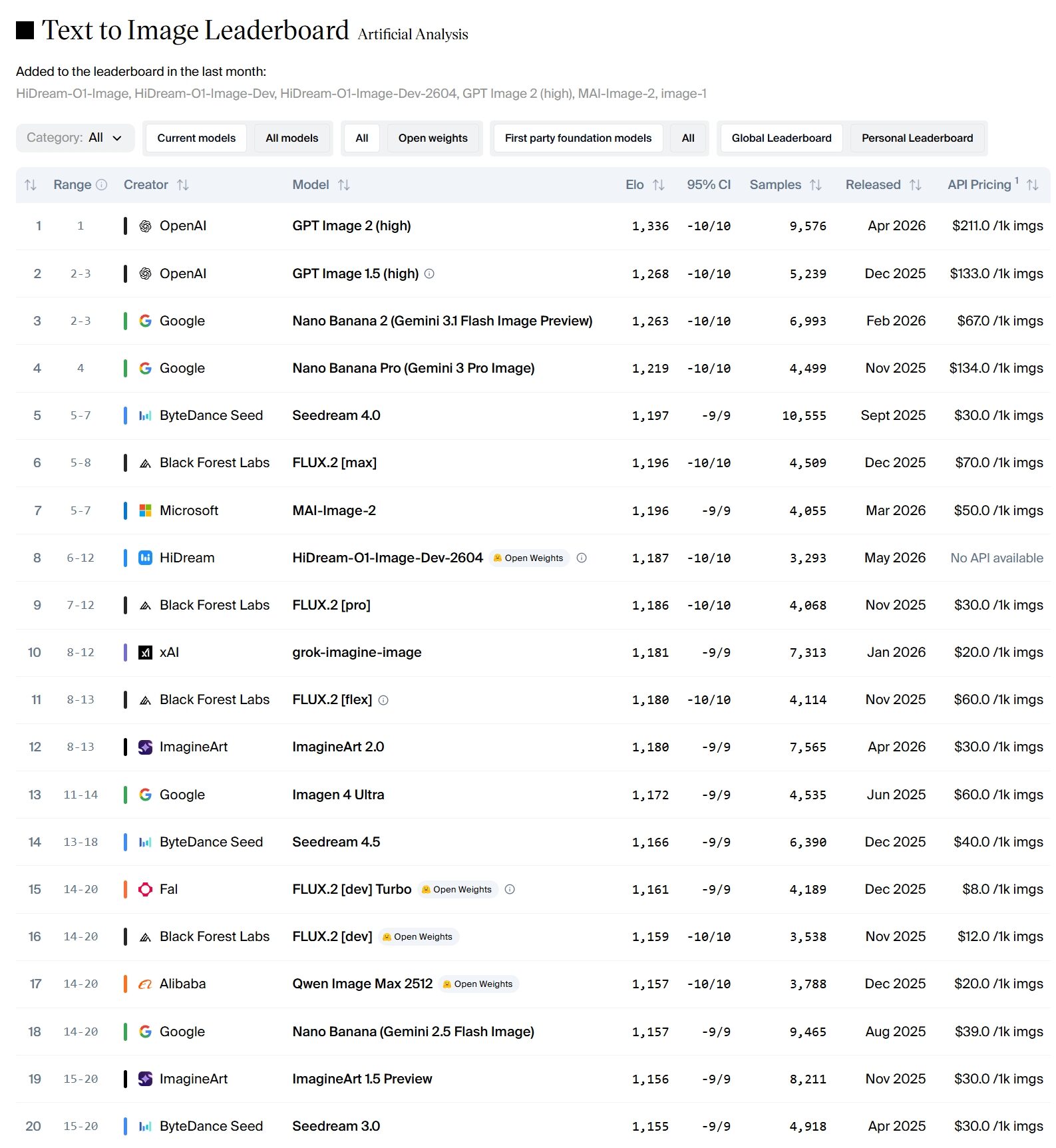
By mid-2026, open-source text-to-image has arrived at a genuine fork in the road. One path, taken by Baidu's ERNIE-Image, is the familiar latent DiT recipe: a VAE compresses the image into small latent patches, a diffusion transformer denoises in that compressed space, and a decoder maps back to pixels. The other path, taken by HiDream-O1-Image, is pixel-native: diffusion runs directly on raw pixels, with no VAE and no external text encoder at all. Both models are 8B, both fully open-source, both free for commercial use — but their underlying philosophies could hardly be more different.
The two releases landed just three weeks apart (ERNIE-Image on April 14, HiDream-O1-Image on May 8, 2026), yet they offer completely different answers on architecture, licensing, and capability boundaries. This article puts both on the same table and compares them across five dimensions: architecture, text rendering, compositional generation, editing, and deployment.

Architecture Philosophy
ERNIE-Image uses the industry's most mature recipe: a single-stream Diffusion Transformer with 8B DiT parameters, paired with a 3B Prompt Enhancer. Images are compressed by a VAE, and diffusion happens in latent space. The payoff is efficiency — diffusion runs at 1/64th the spatial resolution, so a 24GB consumer GPU is enough.
HiDream-O1-Image takes a more radical route. Its Pixel-level Unified Transformer (UiT) feeds pixel patches, text tokens, and task conditions into a single shared sequence with no compression at all. No VAE means no encode-decode round-trip loss; no external text encoder means text and image align within the same attention mechanism. The cost is more compute per token, compensated by sparsity and a predefined timestep schedule — the Dev variant converges in 28 steps at CFG 0.0.

License Comparison
Both models permit commercial use, but with different degrees of looseness. ERNIE-Image is Apache-2.0; HiDream-O1-Image is MIT — shorter, more permissive, with no additional clauses. For teams embedding a model into commercial products, MIT is the "zero-worry" choice; Apache-2.0 adds explicit patent grant terms. In practice the difference is minor, but legal teams should glance at the details.
Text Rendering
Text rendering is where both models shine and where they separate from older generations. On LongText-Bench, HiDream-O1-Image scores 0.979 (EN) / 0.978 (ZH); ERNIE-Image with PE scores 0.9804 (EN) / 0.9661 (ZH), averaging 0.9733. English long-text rendering is nearly a tie; Chinese slightly favors HiDream.

Notably, HiDream's CVTG-2K score of 0.9128 tests exactly the hard case: 2-5 text regions appearing simultaneously in one layout — posters, infographics, multi-panel comics. The pixel-native architecture does appear to hold a structural advantage when multiple text blocks must land in precise positions.
Compositional Generation
Compositional generation tests whether a model can render multiple objects, colors, counts, and spatial relations correctly in one pass. On GenEval overall, HiDream-O1-Image's 0.90 edges out ERNIE-Image's 0.8856 (with PE off). Interestingly, ERNIE-Image scores higher without its Prompt Enhancer (0.8856 vs 0.8728) — the enhancer rewrites prompts, and rewriting can drop precise binding relationships.
Editing Capability
This is the largest gap. HiDream-O1-Image packs text-to-image, instruction-based editing, and subject personalization into a single set of weights, scoring 7.60 on GEdit — comparable to 16.8B FLUX.1 Kontext and 27B Qwen-Image-Edit. Change wall material, shift lighting from noon to dusk, replace chairs with benches — the composition stays intact.
On the ERNIE side, the official editing model still hasn't shipped as of August 2026. The community assembles editing pipelines from Qwen-Image-Edit or FLUX Kontext instead. If you need out-of-the-box editing, HiDream is currently the more complete answer; if you accept a "generate with ERNIE + edit with another model" hybrid, the impact is manageable.
Getting Started
Deployment requirements are very close: ERNIE-Image needs roughly 24GB VRAM; HiDream-O1-Image's full checkpoint runs in about 20GB (official recommendation: A100/H100). Both support Diffusers, and ComfyUI has ready-made workflows for each.
On speed, ERNIE-Image has the edge — the Turbo variant needs only 8 steps at CFG 1.0, one of the fastest 8B-class open models today; HiDream's distilled Dev variant needs 28 steps. For batch generation, choose ERNIE Turbo; for single-image refinement and editing, HiDream.
Ecosystem maturity clearly favors ERNIE-Image: SGLang, Unsloth GGUF quantization, OneTrainer, fal.ai, Replicate, and SiliconFlow all have ready support. HiDream currently relies mainly on its official repo and HF Space, with third-party services still catching up.
How to Choose
In one sentence: choose ERNIE-Image for speed, ecosystem, and Chinese long-text rendering; choose HiDream-O1-Image for native editing, pixel-level detail, and zero-constraint MIT licensing.
By scenario: for e-commerce posters and comic panels — tasks where content accuracy matters most — both qualify, and ERNIE's ecosystem gets you to production faster; for film concept art and character-consistency workflows, HiDream's native editing plus subject personalization is the leaner path; for pure batch generation racing the clock, ERNIE-Image-Turbo has no rival.
The existence of both models matters more than who wins. They prove that the 8B scale can satisfy "open, commercial, high-quality" all at once — and that there is more than one road to high quality. Latent and pixel-native will keep colliding productively through the coming year.